
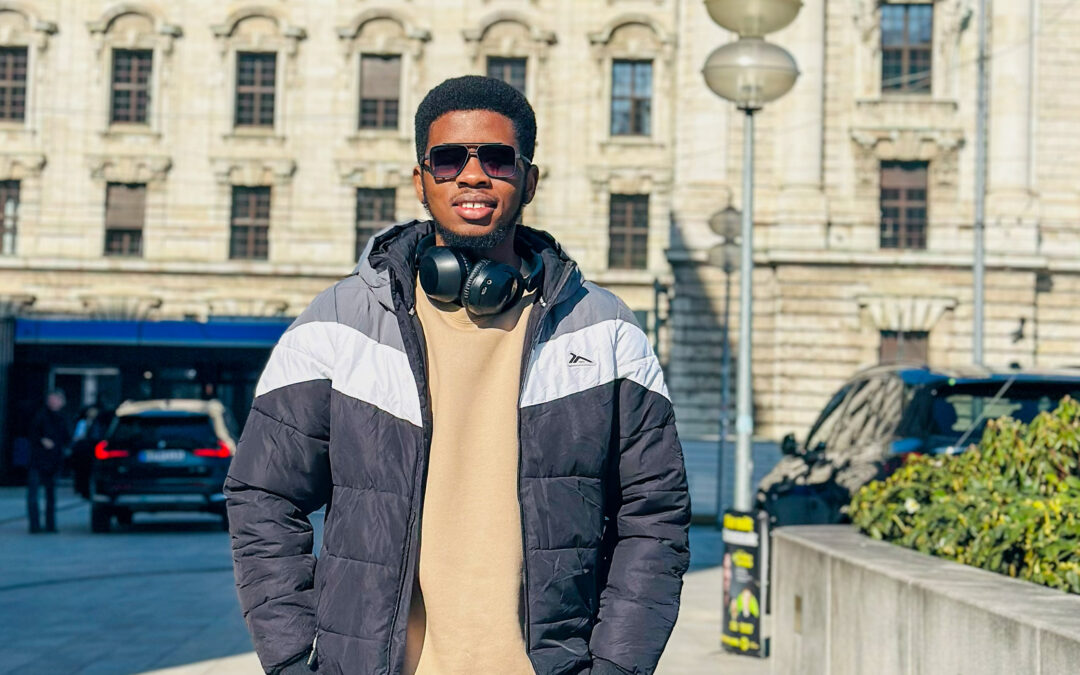
Prince Iragena, a 23-year-old scholarship holder of the Bachner Foundation, has always known that he wanted a career where he could get stuck in and create something tangible. To move closer to this goal, he focused particularly on subjects such as maths, chemistry and physics whilst still at school. It soon became clear that electrical engineering was his thing!
From Rwanda to Germany
“I realised quite quickly that I wanted to do my training – and also build my career – in Germany,” Iragena explains during our conversation. Germany has a very good international reputation in technical professions. “That’s why I started learning German back home in Rwanda. The language is a challenge, as it’s completely different from my mother tongue, Kinyarwanda. I’m currently doing an intensive language course to prepare for my apprenticeship – it’s helping me a lot.”
But how did Iragena, from Rwanda – nearly 6,000 km away – come to hear about the Bachner Foundation in Mainburg? The answer lies in a combination of chance and the Bachner Group’s excellent reputation. “I was talking to a friend who has been working for a car manufacturer in Germany for nine years,” says Iragena. “He knew the Bachner company from a joint project and suggested I apply there. So I did some research and discovered the foundation. After reading an article about George Onyango, another scholarship holder, I decided to just give it a go.”
Helping to shape the future
Iragena then met Hans and Sabine Bachner during a video call. “What struck me most about Prince was his strong commitment and his motivation to pursue a career in Germany,” recalls Sabine Bachner. “But on a personal level, too, we just clicked. That’s why he was the perfect candidate for our foundation.”
Iragena attributes his high level of motivation not least to the history of his home country, Rwanda. Following the genocide against the Tutsi in 1994, the country had to reinvent itself and rebuild many aspects of society. “It may seem unusual at first glance, but the theme of our annual commemorative event, ‘Remember – Unite – Renew’, inspires me to work hard every day and give my best,” says Iragena. For now, however, his priority is to learn the language and settle into life in Germany before he begins his apprenticeship with the Bachner Group in September. There are many things here he has to get used to – the whole mindset is different. “Besides, it’s too cold for me,” he says with a laugh.
Kinyarwanda: the national language of Rwanda
Kinyarwanda belongs to the Bantu language family and is the mother tongue of around 15 million people. It is spoken not only in Rwanda, but also in the Congo and Uganda. Whilst German mostly uses word order, word endings and different cases to convey meaning, Kinyarwanda relies on complex verb forms and, in some cases, multiple prefixes attached to the same word.